Nick Leiber
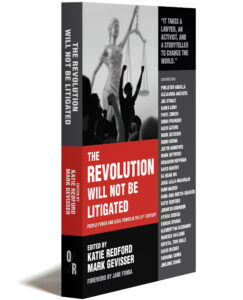
How can attorneys, activists, and others work together to fight more effectively for social justice? An upcoming panel discussion at CUNY Law School seeks to answer this question as the realities of potential genocide in Gaza, climate crisis disasters around the world, and the gun violence epidemic in the U.S. spark despair, anger, and action. Panelists will share examples of collaboration that made a difference against seemingly intractable problems.
Author Archives: CUNY Law Review
Ghost Guns Are Fueling the Gun Violence Epidemic. After Bruen, Can Our Laws Keep Up?
Photo credit: Adam Schultz Creative Commons/Flickr
Nick Leiber
As we are reminded by headlines such as “A School Bus Crosses U.S., Linking Families of Mass Shooting Victims” and “Teens buying ‘ghost guns’ online, with deadly consequences,” our gun violence nightmare doesn’t seem to be ending. More Americans died of gun-related injuries in 2021 than in any other year on record, according to the Centers for Disease Control and Prevention. Perhaps most disturbingly, firearms are now the number one cause of death for children in the U.S., surpassing motor vehicle deaths and those caused by any type of injuries or illness.
Continue reading
Trans Youth Athletes Are Under Attack. It’s Time to Push Back
Hirsha Venkataraman
It’s 2023, and here in the United States, we–or at least some of us–still can’t decide whether or not we want to be on the right side of history. The Supreme Court has gutted abortion rights that existed for decades and allowed a business owner to discriminate against a homosexual couple due to “free exercise of religion.” Will the Court soon be allowing far-right religious zealots to dictate how we treat some of our most vulnerable and marginalized? I am talking about the proliferation of anti-trans legislation sweeping our nation, particularly against transgender athletes and, even more specifically, youth transgender female athletes.
The First Amendment’s True Threats Doctrine Needs Updating. Counterman Ain’t It
Annie Seifullah and Jillian Bowen
The First Amendment of the United States Constitution protects freedom of speech, but this protection is not absolute. True threats, which our courts have identified as statements that frighten or intimidate someone into believing that they will be harmed, are an example of speech that is not constitutionally protected. Because social media, tech platforms, and smart devices are so embedded in the ways humans communicate and connect, what actually constitutes a true threat has become not only a more prevalent inquiry in our courts–but also a more difficult question to answer.
Volume 26.1, Footnote Forum
“Inherently Expressive”: BDS Organizing for Palestinian Liberation at CUNY School of Law and Beyond by Students for Justice in Palestine (SJP) and the Jewish Law Students Association (JLSA), City University of New York (CUNY) School of Law
BDS-Organizing-for-Palestinian-Liberation-at-CUNY-School-of-Law-and-Beyond-26-CUNY-L.-Rev.-67-2023Volume 26.1, Footnote Forum
The Domestic Violence Survivors Justice Act and Criminalized Immigrant Survivors by Assia Serrano & Nathan Yaffe
Abstract
This piece explores how New York’s Domestic Violence Survivors Justice Act (“DVSJA”), a law meant to grant freedom to criminalized survivors, plays out in practice for criminalized immigrant survivors. New York enacted the DVSJA to address the unjust, but common, harsh punishment of survivors for conduct that an abuser compels, coerces, or otherwise causes. When the court grants a survivor DVSJA relief, the material benefit is shortening that survivor’s sentence of incarceration.
However, for criminalized immigrant survivors, the DVSJA’s promise of freedom may amount to little more than a mirage because DVSJA relief does not expunge, vacate, or alter underlying convictions. We situate the DVSJA in its institutional, legal, and policy context: a criminalized survivor’s sentence does not exist in a vacuum. Their sentence is just one part of a broader process of criminalization. This piece fills the gap in the policy discussion, based on the experiences of the first immigrant survivor who was resentenced and released under the DVSJA. In addition to calls for changes in policy and practice, this piece urges New York Governor Kathy Hochul, who has expressed concern for the plight of domestic violence survivors—but largely has not used her clemency power to free criminalized survivors (whether facing deportation or not)—to live up to her stated values through widespread use of the clemency power.
Assia-Serrano-Nathan-Yaffe-The-Domestic-Violence-Survivors-Justice-Act-and-Criminalized-Immigrant-Survivors-26-CUNY-L.-Rev.-F.-24-2023Free Speech, Bullying, and a CUNY Law Grad Who Dared to Criticize Power
Nick Leiber
On May 12, CUNY Law School graduate Fatima Mohammed gave a roughly 13-minute commencement speech to her graduating class as a student-selected speaker at CUNY Law’s graduation ceremony. In it, she shared reflections, offered gratitude, and criticized Israel, the New York Police Department, and the legal system itself. Despite her words clearly meeting First Amendment speech protections, a bullying campaign led to a torrent of negative coverage in right-wing media characterizing her words as antisemitic, calls for depriving CUNY Law of public funding, and public concerns for her safety.
2024 Symposium
“Destroying Democracy from the Inside Out: Legislative, Judicial, and Executive Attacks on the Administrative State”
CALL FOR PAPERS
From the emergence of the major question doctrine and attacks on Chevron deference to the defunding of administrative agencies and the politicization of ALJs, the administrative state is under attack by every branch of the government. For a special Symposium Edition, the CUNY Law Review seeks to publish radical scholarship that addresses the deterioration of American democracy through threats to/the dismantling of the administrative state.
We are looking to publish several short pieces (2-10 pages double-spaced) on legislation, executive orders, and court decisions that undermine the administrative state as a way to stymie justice efforts and the (perhaps few) instances where they work to protect the administrative state. Potential lenses through which we hope to address this issue are: environmental justice, land use, Indigenous rights, labor rights, family law, immigration, and poverty. In keeping with CUNY Law Review’s overall mission, we encourage authors to address this topic from a critical standpoint that highlights issues of systemic racism and injustice.
In addition to submission of a written piece for the Symposium Edition, we are interested in inviting authors to participate in panels at the CUNY Law Review’s 2024 Symposium. If you have a piece that is ready, in the works, or that you are interested in developing that fits within this topic, please reach out to:
Symposium Editor Arpita Vora at arpita.vora@live.law.cuny.edu as soon as possible and no later than September 15, 2023 with a submission or abstract as well your resume or CV.
We welcome contributions from legal academics, practitioners, students, and organizers.
The City University of New York (CUNY) School of Law is one of the nation’s leading public interest law schools and prepares hundreds of attorneys every year to fight for social justice. The CUNY Law Review is an independent, student-run publication devoted to producing public interest scholarship and recognized as one of the leading civil rights journals in the country.
CUNY Law Review Statement on Last Week’s Supreme Court Rulings
Last week, the United States Supreme Court released a series of critical decisions on ending affirmative action in higher education programs—other than military academies—, blocked student loan forgiveness, and expanded a business owner’s right to refuse services to same-sex couples. Continue reading