“What if You’re Disabled and Undocumented?”: Reflections on Intersectionality, Disability Justice, and Representing Undocumented and Disabled Latinx Clients

Elizabeth Butterworth

Volume 26.2 (download PDF)

Abstract

In Care Work: Dreaming Disability Justice, Leah L. Piepzna-Samarasinha asks a series of questions to illustrate how disability rights law fails to address the needs of those who experience multiple systems of oppression, including: “What if you’re disabled and undocumented?” This article draws on research from across disciplines, with a focus on personal narratives, to reflect on and respond to Piepzna-Samarashinha’s question, specifically with regard to the experience of immigrants who are disabled, undocumented, and Latinx. As such, it centers disability justice analyses and describes how ableism and white nationalism are mutually reinforcing bedrocks of immigration law, and how the immigration system interacts with disability law to restrict disabled and undocumented Latinx immigrants from accessing services and exercising rights.

The article begins by establishing the disability justice framework and its critique of the disability rights movement as both insufficiently intersectional and insufficiently transformative. The article then examines the multiple ways that the immigration system is ableist and disabling: from categories like public charge that have always explicitly valued and devalued individuals based on ability/disability, to restrictions that force immigrants to make an often-disabling journey from Central America to the southern border, to white nationalist rhetoric and policy that deter immigrants from seeking healthcare. The article turns to disability law, and explains how the interaction of an immigration system (which punishes accessing services) and disability law (which often frames access to services as either an end goal of, or a core component of, disability rights) work together to maintain ableist oppression. At the same time, the article centers narratives of Latinx immigrants across multiple contexts that highlight individual and collective action to secure care and support outside of formal legal frameworks.

In addition to making a theoretical contribution, this article is informed by the author’s experiences in civil legal aid clinics, supporting clients as they run up against multiple legal and practical barriers to accessing services to which the law entitles them. One goal of the article is to open a conversation among civil legal aid practitioners, who often represent disabled and undocumented clients on matters that are explicitly related neither to disability nor to immigration, and pushes them toward a more transformative understanding of their work. To that end, this article is explicitly addressed to practitioners and concludes with a list of suggestions for re-framing approaches to civil legal aid.

Elizabeth-Butterworth-What-if-Youre-Disabled-and-Undocumented-26-CUNY-L.-Rev.-139-2023
No Settled Law on Settled Land: Legal Struggles for Native American Land and Sovereignty Rights

Laura Waldman

Volume 26.2 (download PDF)

Abstract

Since the early years of colonization, Native American people have engaged in continuous legal struggles for land and sovereignty, which have exposed the colonial underpinnings and white supremacist worldview that are the root cause of their ongoing subjugation. In modern times, that often takes the form of government-backed corporate control over natural resources. This note traces the historical links from treaty violations by early white settlers for the purpose of usurping plantation land and gold, to recent incursions by companies building unwanted oil and gas pipelines on Native American lands.

Both then and now, using law as a tool of resistance has had varying results. On the one hand, there are countless instances where the law has been used as a weapon against Indigenous sovereignty, for example allotment leveraged property law to further divide Native American lands, as well as Native American people from their land. The European conceptions of how property ought to be used, enshrined in laws that require land claims to be exclusive, have consistently deprived Native American nations of decision-making over their lands. On the other hand, some treaties have been successful in ensuring enforcement of environmental protections on Indigenous land.

Moreover, the framework that forms the basis for many rights, that tribal membership is a political rather than a racial designation, has been reaffirmed by the Supreme Court. And, though recent judicial efforts to undermine the protective relationship the federal government has with Native American nations have been successful, there is room for deeper understandings of Native American sovereignty to emerge into law—understandings based on inherent, rather than relational sovereignty.

Laura-Waldman-No-Settled-Law-on-Settled-Land-26-CUNY-L.-Rev.-220-2023

Volume 26.1

We are excited to publish Volume 26.1. The full journal is available at CUNY Academic Works. Please see below for individual articles:

Front Matter

Articles

Extradition in Post-Roe America

Alejandra L. Caraballo, Cynthia Conti-Cook, Yveka Pierre, Michelle McGrath, Hillary Aarons

High Risk Hustling: Payment Processors Sexual Proxies and Discrimination by Design

Zahra Stardust, Danielle Blunt, Gabriella Garcia, Lorelei Lee, Kate D’Adamo, Rachel Kuo

Notes

Comments

Public Interest Practitioner Section

Volume 25.2

We are excited to publish Volume 25.2. The full journal is available at CUNY Academic Works. Please see below for individual articles:

Front Matter

Articles

Racist Animal Agriculture

Courtney G. Lee

Notes

Comments

Public Interest Practitioner Section

Regulatory Theater: How Investor-Owned Utilities and Captured Oversight Agencies Perpetuate Environmental Racism

Ruhan Nagra, Jeanne Bergman, & Jasmine Graham

Footnote Forum

Cruel and Usual: Contaminated Water in New York State Prisons

Shannon Haupt & Phil Miller

Footnote Forum Podcast

Cruel and Usual

Michael Maskin, Shannon Haupt, Jennifer Grossman, Panagioti Tsolkas, Phil Miller, & Ramon Henriquez

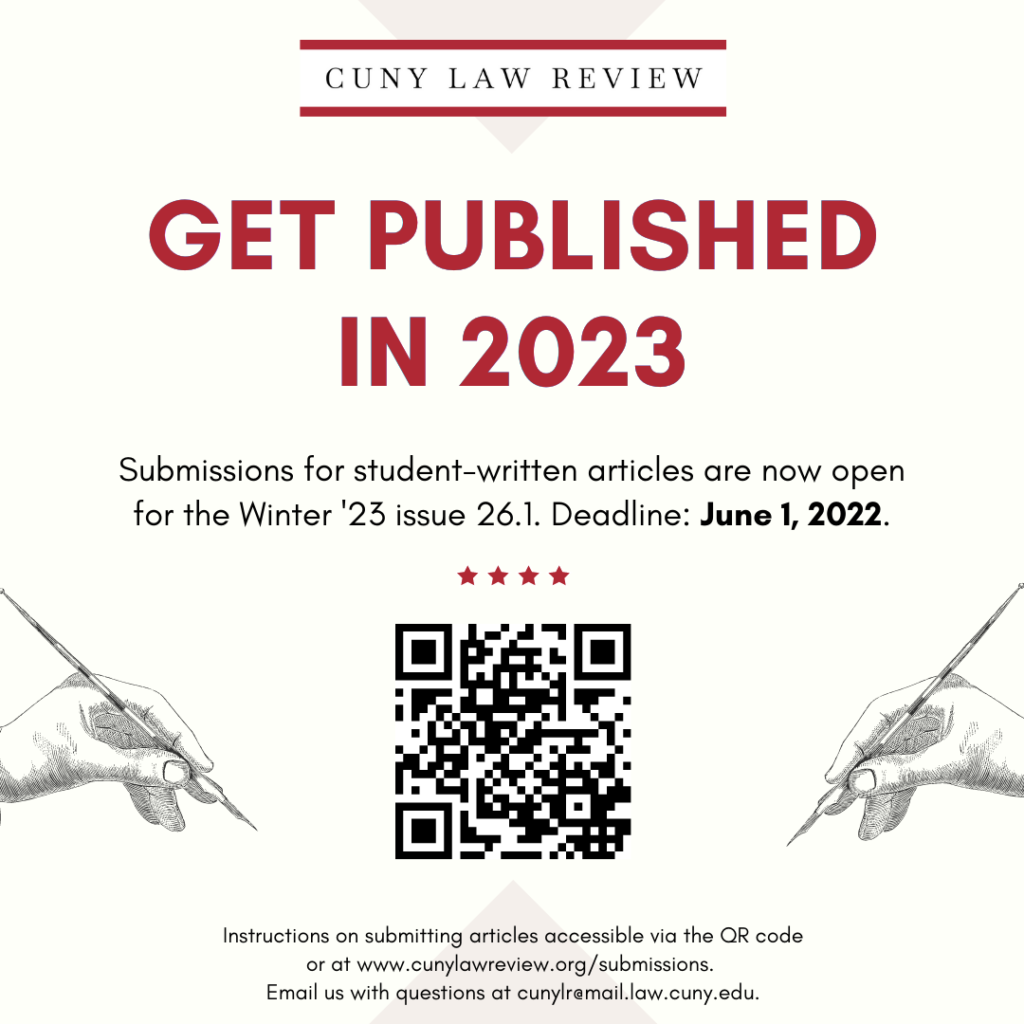
Call for Student Submissions – Volume 26.1

Interested in getting published in CUNY Law Review? We are currently accepting submissions for student-written articles to be published in our Winter 2023 issue (26.1). CUNY Law Review seeks to uplift student authors and welcomes submissions from all law students for the Notes and Comments section. Students are encouraged to see Notes and Comments as a platform to publish their work, along with the Footnote Forum and the CUNY Law Review Blog

Submissions should be emailed to salimah.khoja@live.law.cuny.edu and sulafa.grijalva@live.law.cuny.edu no later than June 1st. For general questions, please email cunylr@mail.law.cuny.edu.

Scan the QR code for more details!

Volume 25.1 – CUNY Law Review 25th Anniversary Issue

We are excited to announce the publication of the 25th Anniversary Volume of CUNY Law Review, Volume 25.1! The full journal is available at CUNY Academic Works. Please see below for individual articles:

Front Matter

Articles
Restorative Justice in Cases of Sexual Harm
Alexa Sardina and Alissa R. Ackerman

Supreme Confusion About Causality at the Supreme Court
Issa Kohler-Hausmann and Robin Dembroff

Who’s Afraid of Bob Jones? “Fundamental National Public Policy” and Critical Race Theory in a Delicate Democracy
Lynn D. Lu

Notes
Challenging Weapons Deals Between the United States and Israel: Limitations and Prospects
Ryan J. McNamara

Comments
Casting Out from the Inside: Abolishing Felony Disenfranchisement in New York
Elizabeth Neuland

Public Interest Practitioner Section
Elderly, Detained, and Justice-Involved: The Most Incarcerated Generation
Rachael Bedard, Joshua Vaughn, and Angela Silletti Murolo

Footnote Forum
The Impeachment Trials of Donald John Trump: How Senate Jurors Strengthened the Case Against Federal Felon-Juror Exclusion
James M. Binnall

Footnote Forum Podcast
Challenging Reform: A Formerly Incarcerated Student Roundtable Discussion
Colby Williams, Phil Miller, and Jordan Sudol
Listen to the audio recording here

Volume 25.1, Footnote Forum, Part 2

We are pleased to publish Volume 25.1, Footnote Forum, Part 2!

In this installment, we present articles written by two currently incarcerated authors who speak to us from their personal experiences. In The Correctional Institute of Nothing, Frank Pruitt writes about his desire for more holistic treatment opportunities in prison, the lack of which he has witnessed for 30 years. Next, in Why Reforms Are not Enough: Justice and Accountability Reimagined, Felix Sitthivong details how abolitionist ideals are vital to many incarcerated people and how reforms fall short of those ideals.

Footnote Forum will publish Part 3 in February 2022. For Part 1, please click here. The full journal is available at CUNY Academic Works. Please see below for individual articles:

The Correctional Institute of Nothing by Frank Pruitt

Q&A with Frank Pruitt by Frank Pruitt

Why Reforms are Not Enough: Justice and Accountability Reimagined by Felix Sitthivong

Q&A with Felix Sitthivong by Felix Sitthivong

Volume 25.1, Footnote Forum, Part 1

We are excited to publish Volume 25.1, Footnote Forum, Part 1. This installment features David Campbell, a former political prisoner, who discusses what “defunding the police” and “reinvesting in communities” could mean if reinvestment took the form of paying incarcerated workers suitable wages. Professor Steve Zeidman, Director of the Defenders Clinic at CUNY School of Law, writes on the notion of whether prosecutors can actually be progressive.

Footnote Forum exists to challenge our assumptions about legal scholarship. For Volume 25.1, we invite readers to consider the value of lived experiences. What can the lives of those directly impacted by the criminal legal system teach us, especially when they have no access to databases normally used for legal research? Does this perspective provide a fuller understanding of the law, and is that valuable for scholarship?

– Natasha Bynum and Colby Williams, Footnote Forum Editors

Footnote Forum is publishing Parts 2 and 3 in December 2021 and February 2022. The full journal is available at CUNY Academic Works. Please see below for individual articles:

Footnote Forum, Part 1

Editors’ Note by Natasha Bynum and Colby Williams

Virtuous Prosecutors? by Steven Zeidman

Decarceration Means Funding the Incarcerated by David Campbell

Q&A with David Campbell by David Campbell

Volume 24.2

We are excited to publish Volume 24.2. The full journal is available at CUNY Academic Works. Please see below for individual articles:

Articles
Voting Rights Lawyering in Crisis by Emily Rong Zhang

Notes and Comments
Trans Adults Deserve a Right to Sue for Gender-Affirming Care Denied at Youth by Eliza Chung

Public Interest Practitioners Section (PIPS)
Paradox and Possibility: Movement Lawyering During the COVID-19 Housing Crisis by Marika Dias

Footnote Forum
Reviving the Civic Body: Campaign for Suffrage Inside Prisons, Felony Enfranchisement in D.C., and Lawyering for Abolition by Uruj Sheikh

Footnote Forum Podcast
Freedom Should Be Free: An Interview with The Bail Project by Rachel Goldman, Megan Diebboll, and Asia Johnson
Listen to the audio recording here

Volume 23.2

We are excited to publish Volume 23.2, see below for specific articles:

Articles
Why Matter of Devera Matters: Universal Pre-K, Quality, Oversight, and the Need to Restore Public Values in New York Statutory Interpretation by Natalie Gomez-Velez

Notes and Comments Section
The Fight for NYCHA: RAD and the Erosion of Public Housing in New York by Kyle Giller
Ethical Mediation in an Unjust World: Claiming Bias and Negotiating Fairness by Jessica Halperin
The Impact of the #MeToo Movement on Defamation Claims Against Survivors by Shaina Weisbrot

Public Interest Practitioner’s Section
Permanently Residing Under Color of Law: A Practitioner’s Guide to an Ambiguous Doctrine by Steven Sacco and Sarika Saxena

Footnote Forum
Traumatized to Death: The Cumulative Effects of Serial Parole Denials by Richard Rivera

Footnote Forum Podcast
Interview with Dilley Delegation Staff
CUNY School of Law Dilley Delegation FOIA Request by CUNY Dilley Delegation