Special thanks to our new staff members for contributing to a solid start this semester:
Sara Bovill
Jean Fischman
John Paul Guyette
Sana Khashang
Rachel Nager
Brendan Rush
Steve Succop
Special thanks to our new staff members for contributing to a solid start this semester:
Sara Bovill
Jean Fischman
John Paul Guyette
Sana Khashang
Rachel Nager
Brendan Rush
Steve Succop
Mclee Kerolle*
Click here for a recommended citation and to download a paginated PDF version of this article.
Introduction
On April 10, 2013, the Obama Administration released its proposed budget for 2014 with initial reviews showing that there would be a $200 million cut for NASA’s planetary exploration program.[1] Critics against the cut, such as Planetary Society CEO Bill Nye, have spoken out about the crippling effect the cuts will have on future missions and the cuts potential to reverse a decade’s worth of investment building the world’s premier exploration program.[2] On the other hand, proponents of the budget have praised it for its approval of $105 million for a mission to capture an asteroid so that it can be explored by 2015, as well as its funding for ongoing human spaceflight and support for private space taxis that could launch astronauts to and from the International Space Station.[3] Irrespective of the divisions the budget proposal has caused among those in the space industry, one thing is for certain: the space industry is going through a resurgence. Not since the Space Race has there been more of a reason for people to be excited about what lies ahead. Rightfully so, considering that despite budget cuts and perceived setbacks from the public (such as the retirement of NASA’s space shuttle program in 2011) the space industry is now a $250 billion per year global market.[4]
Our latest Footnote Forum installation comes from Professors Janet M. Calvo, Shirley Lung, and Alizabeth Newman.*
Janet M. Calvo, Shirley Lung, Alizabeth Newman†
Click here for a recommended citation and to download a paginated PDF version of this article.
Non-citizens who are afforded Deferred Action for Childhood Arrivals (DACA) qualify for New York State bar membership. Over four hundred thousand young people in the United States have been approved for DACA, a program for non-citizens who came to the United States as children.[1] Approximately one percent of DACA-eligible non-citizens have pursued graduate education,[2] including law school. The admission of those approved for DACA to the bar is supported by New York statutes and the constitutional jurisprudence of the United States Court of Appeals for the Second Circuit and the New York Court of Appeals. The New York Judiciary Law explicitly precludes alienage as a basis for denial of bar admission. New York has a history of routinely admitting non-citizens to the bar; there is no categorical exclusion from bar admission of any particular category of law graduates based on immigration status. An individual’s immigration category does not determine whether he or she possesses the skills, competence, and moral character to serve as an advocate in the courts of New York and to ethically represent the best interests of clients.
Caitlin E. Borgmann[1]
Click here for a recommended citation and to download a paginated PDF version of this article.
Introduction
One might expect that a Supreme Court decision addressing the constitutionality of a citizen initiative that bars marriage between same-sex couples would yield a predictable political division among both the Justices and Court commentators. Liberal Justices and commentators, one might conjecture, would want the Court to recognize a fundamental constitutional right to marriage equality, while conservative Justices and commentators would prefer the issue be left to the political process. The Supreme Court’s recent decision in Hollingsworth v. Perry reflected no such tidy outcome, however. The majority opinion addressing California’s Proposition 8 (“Prop 8”), which amended the state’s constitution to exclude same-sex couples from legally recognized marriage, sidestepped the substantive issue through a procedural maneuver. Rather than reach the merits, the Court held that the official proponents of Prop 8, who had defended its constitutionality both in the district court and on appeal, lacked standing to appeal the district court’s opinion invalidating the initiative. The Court’s decision left marriage equality as the rule in California (although not elsewhere). Liberal Justices Breyer, Ginsburg, and Kagan joined Chief Justice Roberts’s majority opinion, as did Justice Scalia, while conservative Justices Thomas and Alito, and liberal Justice Sotomayor, joined Justice Kennedy’s vigorous dissent. Some liberal commentators who favor marriage equality applauded the Court’s decision.[2]
It is of course not possible to know exactly what motivated each of the Justices in Hollingsworth. But standing is a doctrine that the Court has notoriously manipulated to reach desired results on the merits.[3] Commentators have widely speculated that the liberal Justices who sided with the majority preferred not to reach the merits either because they believed there were insufficient votes to find Prop 8 unconstitutional,[4] or because they believed such a decision might be politically premature and therefore counterproductive, as it might prompt a backlash.[5] Some proponents of marriage equality were quietly relieved by the Court’s refusal to address the merits, since it allowed the district court’s invalidation of Prop 8 to stand without risking an adverse Supreme Court decision that would be binding on all states.[6]
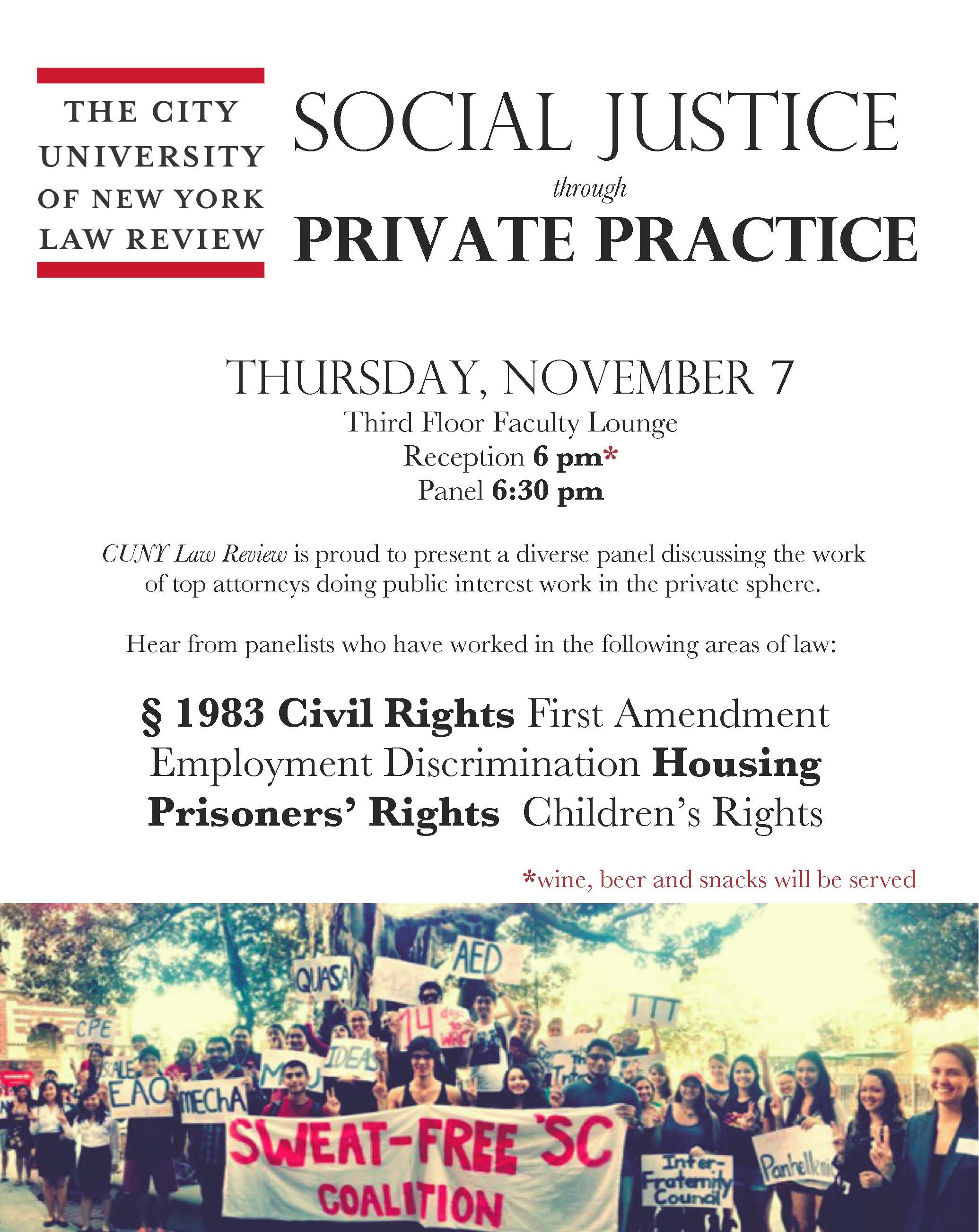
Panel will feature the following guests, who bring experience in diverse areas of the law such as tenants’ rights, labor and employment, First Amendment, prisoners’ rights, civil rights, police brutality, and government misconduct:
Join us in the 3rd floor Faculty Lounge at 6 p.m. for a food and wine reception. Panel will begin at 6:30 p.m.
*please note the name change
The City University of New York Law Review is seeking submissions for its Summer 2014 issue, which will continue the journal’s tradition of advancing legal scholarship highlighting the touchstones of our publication’s work—including civil rights, progressive legal reform, the impact of the law on minorities and marginalized communities, international human rights, and attorneys’ insights on how recent developments in the law have affected their public-interest practices in New York and beyond.
We are interested in one-page abstracts or finished manuscripts you may have for consideration by our editorial board. Submissions should be remitted to cunylr@law.cuny.edu. Abstracts will be considered through December. Finished manuscripts for approved abstracts have a deadline of December 31, 2013. Offers to publish and final decisions on all submissions will be made on a rolling basis and will be finalized by mid-January 2014.
In addition, the journal is seeking shorter, more time-sensitive contributions—such as comments on recent federal or state case law, critiques of legislative proposals, and legally relevant analyses of current events—for inclusion in our evolving digital platform at the City University of New York Law Review website at www.cunylawreview.org. Submissions for digital consideration should be sent directly to our Digital Articles Editor at ldavis@mail.law.cuny.edu.
Our upcoming Winter 2014 issue includes scholarly works on a range of public interest legal issues, with an emphasis on practical application. Some examples include articles about the hurdles of providing on-the-ground legal assistance after natural disasters such as Hurricane Sandy; the impact of family instability on access to education for children with disabilities; gender inequality in granting asylum requests; how language impairments impact attorney-client relationships; applying a human rights framework in determining services for youth aging out of foster care; policy arguments in favor of stronger single-room occupancy regulations aimed at solving the housing crisis in New York City; and applying contract law to strengthen Individual Education Plans.
We look forward to reading and discussing your manuscript for possible publication, and kindly invite you to forward this letter to other social-justice scholars and practitioners who may be interested in publishing with us.
With our warm regards,
Tatenda, Caitlin, Kate & Cristian
On behalf of the City University of New York Law Review Editorial Board
CUNY Law Review will be hosting a panel with the theme “How to Keep Your Soul in the For-Profit World” on November 7th in the Faculty Lounge. Reception at 6 pm, Panel at 6:30 pm.
Details to follow.
We are proud to introduce Prof. Janet Calvo’s discussion of the Windsor decision’s impact on immigration law as part of our ongoing series of web-exclusive pieces by professors, students, practitioners, and others who aim to share timely legal commentary in Footnote Forum, the online companion of the Law Review. For more on this opinion, see Prof. Ruthann Robson’s related piece.
Janet M. Calvo*
Click here for a recommended citation and to download a paginated PDF version of this article.
The Defense of Marriage Act (DOMA), barred federal immigration authorities[1] as well as other federal officials from recognizing same-sex marriages. Now that DOMA has been declared unconstitutional in U.S. v. Windsor,[2] the federal officials that implement immigration law have declared that same-sex marriages will be recognized to the same extent as opposite-sex marriages. This has implications for several aspects of immigration law and practice. On July 1, 2013 the Secretary of Homeland Security directed the U.S. Citizenship and Immigration Services (USCIS) “to review immigration visa petitions filed on behalf of a same-sex spouse in the same manner as those filed on behalf of an opposite-sex spouse,”[3] and the USCIS posted additional information about implementation.[4] On August 2, the Secretary of State similarly stated “when same-sex spouses apply for a visa, the Department of State will consider that application in the same manner that it will consider the application of opposite-sex spouses,”[5] and the Department of State website provided further detail, in line with the USCIS position.[6]
Further, on July 17, 2013, the Board of Immigration Appeals (BIA) issued a decision[7] stating that DOMA was no longer an impediment to recognition of same-sex marriages; therefore, a same-sex spouse would be recognized under immigration law if the marriage were valid in the state in which it was celebrated, and was bona fide.[8] This case involved the non-citizen same-sex spouse of a U. S. citizen who had filed a petition on behalf of that spouse. The Director’s determination had found that the marriage was valid under the laws of Vermont where the marriage was celebrated, but did not grant the petition. The BIA held that, after Windsor, the sole remaining issue was whether the marriage was bona fide—i.e., whether the marriage was entered into solely for the purposes of immigration—and remanded the case to allow the Director to make that determination.