Case Comment: United States v. Windsor

We are proud to introduce Prof. Ruthann Robson’s comment on United States v. Windsor as part of our ongoing series of web-exclusive pieces by professors, students, practitioners, and others who aim to share timely legal commentary in Footnote Forum, the online companion of the Law Review. For a discussion of this decision’s impact on immigration law, see Prof. Janet Calvo’s related piece.

Ruthann Robson*

Click here for a recommended citation and to download a paginated PDF version of this article.

A landmark. A victory for “gay rights.” An example of judicial activism.

Each of these appellations is an accurate descriptor of the Court’s decision in United States v. Windsor, rendered on the last day of the 2012–2013 term. By a bare majority, the Court declared Section 3 of the Congressional Defense of Marriage Act (DOMA) prohibiting federal recognition of same-sex marriages unconstitutional. The Court resolved the threshold issue of whether it had Article III power to hear the case, given the unusual posture of the litigation, in favor of rendering a decision, unlike the outcome in the companion case of Perry v. Hollingsworth involving the constitutionality of California’s Proposition 8.[1] The Court’s reasoning included a discussion of Congressional power to pass DOMA, given that marriage and other family matters are generally within the province of the states under federalism as it has developed in the United States. Ultimately, however, the issue was not one of Congressional power. Instead, the majority concluded that DOMA’s Section 3 violated the equal protection component of the Fifth Amendment.

The facts underlying United States v. Windsor have been subject to much media attention. Edith Windsor is a sympathetic and charismatic plaintiff, aged 83 at the time of the decision, whose monetarily specific injury consisted of the $363,053 she paid to the federal government in federal estate taxes because of the non-recognition of her same-sex marriage to her deceased partner, Thea Spyer.[2] The couple had been married in Canada in 2007, and their marriage was recognized by their home state of New York when Thea Syper died in 2009, although New York itself did not itself license same-sex marriages until 2011.[3] Thus, except for the operation of DOMA Section 3, Edith Windsor would have been considered a “spouse” under federal law and entitled to the spousal exemption from estate tax.
Continue reading

EVENT: Judiciary Night

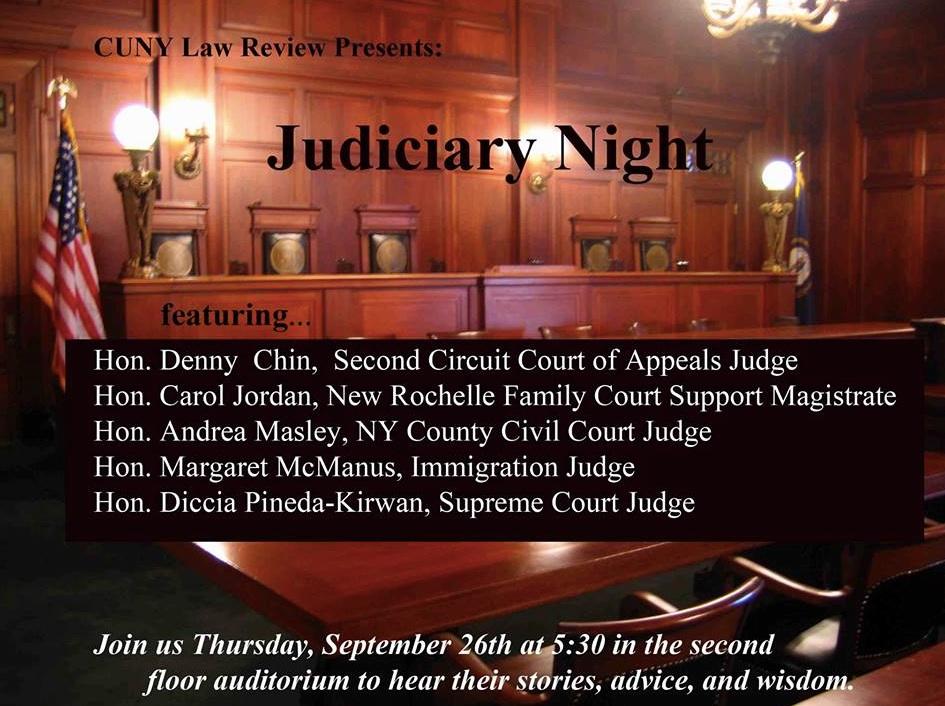
Judiciary Night Poster

Poster Courtesy of the Special Events Editors

CUNY Law Review invites you to the 2013 Judiciary Night on September 26, 2013 from 5:30 to 9:00 p.m.

The CUNY Law Review Board is orchestrating a diverse panel of judges from New York and will facilitate what we hope will be an engaging dialogue.

The following judges will be in attendance:

Hon. Denny Chin
Judge, Second Circuit Court of Appeals

Hon. Carol Jordan
Support Magistrate, New Rochelle Family Court

Hon. Andrea Masley
Judge, Civil Court of the City of New York

Hon. Margaret McManus
Immigration Judge, EOIR Immigration Court, New York City

Hon. Diccia Pineda-Kirwan
Judge, Supreme Court of the State of New York, Queens County

The panel will be followed by a wine and dinner reception
around 8pm (Vietnamese food with vegetarian, vegan, and
gluten-free options). We hope to see you there!

UPDATE: We are pleased to announce that the event will be
moderated by Prof. Donna Hae Kyun Lee. It will take place
in the auditorium on the second second floor. Directions to CUNY
School of Law can be found here.

Event: Tribute to Justice

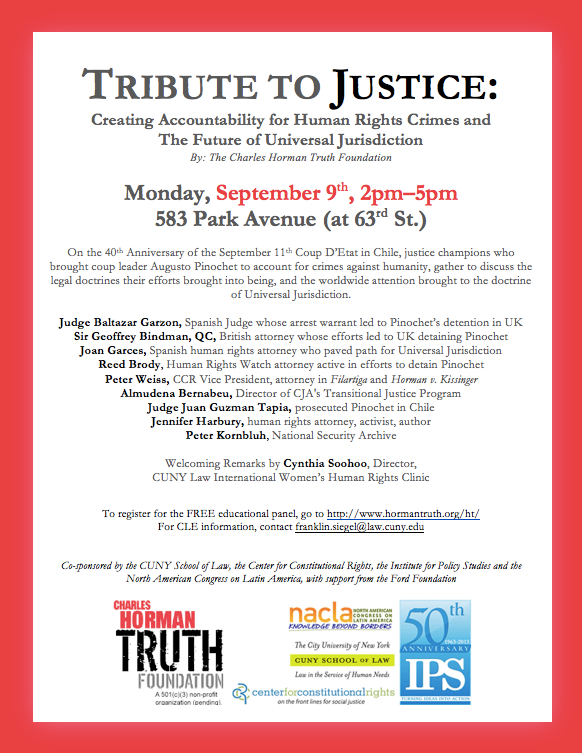
Final Horman Tribute FlierTribute to Justice:
Creating Accountability for Human Rights Crimes and The Future of Universal Jurisdiction
By: The Charles Horman Truth Foundation

Monday, September 9th, 2pm–5pm
583 Park Avenue (at 63rd St.)

On the 40th Anniversary of the September 11th Coup D’Etat in Chile, justice champions who brought coup leader Augusto Pinochet to account for crimes against humanity gather to discuss the legal doctrines their efforts brought into being, and the worldwide attention brought to the doctrine of Universal Jurisdiction.

Judge Baltazar Garzon,
Spanish Judge whose arrest warrant led to Pinochet’s detention in UK

Sir Geoffrey Bindman, QC,
British attorney whose efforts led to UK detaining Pinochet

Joan Garces,
Spanish human rights attorney who paved path for Universal Jurisdiction

Reed Brody,
Human Rights Watch attorney active in efforts to detain Pinochet

Peter Weiss,
CCR Vice President, attorney in Filartiga and Horman v. Kissinger

Almudena Bernabeu,
Director of CJA’s Transitional Justice Program

Judge Juan Guzman Tapia,
prosecuted Pinochet in Chile

Jennifer Harbury,
human rights attorney, activist, author

Peter Kornbluh,
National Security Archive

Welcoming Remarks by Cynthia Soohoo, Director,
CUNY Law International Women’s Human Rights Clinic

To register for the FREE educational panel, go to http://www.hormantruth.org/ht/ 
For CLE information, contact franklin.siegel@law.cuny.edu

Co-sponsored by the CUNY School of Law, the Center for Constitutional Rights, the Institute for Policy Studies and the North American Congress on Latin America, with support from the Ford Foundation

Vol. 16.1: A Celebration OF CUNY School of Law Scholarship

Quote

Explore the digital version of our most recent print edition, Volume 16.1, which celebrates legal scholarship at CUNY School of Law.

Introduction by Andrea McArdle, Professor of Law, faculty advisor to the Law Review, and director of the writing curriculum at the City University of New York School of Law

Remarks

Fixing New York’s Broken Bail System by Justine Olderman, Managing Attorney of the Criminal Defense Practice at Bronx Defenders

Articles

Structured Discrete Task Representation to Bridge the Justice Gap: CUNY Law School’s Launchpad for Justice in Partnership with Courts and Communities by Natalie Gomez-Velez, Professor of Law at City University of New York School of Law

“Hallowed By History, But Not By Reason”: Judge Rakoff’s Critique of the Securities and Exchange Commission’s Consent Judgment Practice by Michael C. Macchiarola, Distinguished Lecturer at City University of New York and Adjunct Professor at City University of New York School of Law

Notes

Wage Theft in New York: The Wage Theft Prevention Act as a Counter to an Endemic Problem by Lauren K. Dasse, Staff Attorney at the Florence Immigrant and Refugee Rights Project, City University of New York School of Law Class of 2012, and Editor-in-Chief of CUNY Law Review 2011–2012

Evaluation as the Proper Function of the Parole Board: An Analysis of New York State’s Proposed Safe Parole Act by Amy Robinson-Oost, City University of New York School of Law Class of 2013, and Managing Editor of CUNY Law Review 2012–2013

Public Interest Practitioner Section (PIPS)

Common Law’s Lawyering Model: Transforming Individual Crises Into Opportunities for Community Organizing by Karen Gargamelli and Jay Kim, City University of New York School of Law Class of 2007 and Common Law co-founders and staff attorneys

Reflections on the history and future of the voting rights act in the wake of Shelby County

We are proud to launch Footnote Forum, CUNY Law Review’s new online companion featuring web-exclusive pieces by professors, students, practitioners, and others who aim to share timely legal commentary. Download the inaugural installation, CUNY Law Professor Frank Deale’s Reflections On the History and Future of the Voting Rights Act In the Wake of Shelby County, or keep reading below.

Frank Deale*

I.

At the conclusion of America’s deadliest military conflict, the United States Congress sought to reconstruct a nation torn apart by civil war by enact­ing a program of radical social change designed to eliminate the legal disabilities shouldered by the newly freed African-American male population. Included in the numerous proposals was a series of Amendments to the U.S. Constitution: the 13th Amendment would abolish the institution of slavery; the 14th Amendment would provide equal protection and due process under law to those with former slave status; and the 15th Amendment would enable them to protect these rights via a right to vote, unencumbered by “race” or “color” discrimination. The Congress was empowered to enforce this provi­sion with appropriate legislation.

Less than 50 years after the enactment of these historic provisions, a substan­tial number of African-Americans went to polling stations in the state of Alabama, the home of Shelby County, seeking to register as voters for an upcoming election. In flagrant violation of the language in the Constitution, they were turned away because of their race. Undaunted, over 5,000 of them joined a civil case to enforce the Constitution, which was heard by the Su­preme Court of the United States. The Court correctly understood the gist of the plaintiffs’ complaint, which was that “the great mass of the white popula­tion intends to keep the blacks from voting.”[1] Yet, notwithstanding the stark nature of the facts, the Court denied relief, concluding that:

Continue reading

Vol. 15.2: Looking Forward

Quote

Explore the digital version of Volume 15.2, our symposium issued entitled “Looking Forward: Rhonda Copelon’s Legacy in Action and the Future of International Women’s Human Rights Law.”

Introduction

Looking Forward: An Introduction to the Symposium Issue by Lauren K. Dasse, City University of New York School of Law Class of 2012 and Editor-in-Chief of CUNY Law Review, 2011–2012

Reflections

Looking Forward: Rhonda Copelon’s Legacy in Action by Cathy Albisa, Executive Director and co-founder of the National Economic & Social Rights Initiative (NESRI)

Legacy in Action: Honoring the Life Work of Rhonda Copelon by Lisa Davis, Clinical Professor of Law in the International Women’s Human Rights (IWHR) Clinic and advisor to the Law Review at the City University of New York School of Law

Rhonda Copelon: A Celebration of a Life Fully Lived by Charlotte Bunch, Founding Director and Senior Scholar of the Center for Women’s Global Leadership at Rutgers University and Distinguished Professor in Women’s and Gender Studies

Remembering Rhonda by Peter Weiss, Vice President of the Center for Constitutional Rights

Selected Remarks

“Crucial as Bread”: Remembering Rhonda Copelon’s Pioneering Work by Yifat Susskind, Executive Director of MADRE

Roadmap to a Bolder Future: Rhonda Copelon’s Legacy by Vincent Warren, Executive Director of the Center for Constitutional Rights

Creating Legacy Today: The First LGBT Ruling by the Inter-American Court of Human Rights by Jessica Stern, Executive Director of the International Gay and Lesbian
Human Rights Commission (IGLHRC)

Living the Legacy of Rhonda Copelon by Andrea J. Ritchie, police misconduct attorney, organizer, and current coordinator of Streetwise & Safe

Reproductive Rights at Home and Abroad by Nancy Northup, President of the Center for Reproductive Rights

Change Is Possible: The Law as a Barrier and a Tool by Marianne Møllmann, Senior Policy Advisor at Amnesty International

Rape in a Post-Disaster Context: Evolving Jurisprudence of the Inter-American Commission by Blaine Bookey, Associate Director and Staff Attorney at the Center for Gender & Refugees Studies at the University of California, Hastings College of the Law

Rape as a Form of Torture: The Experience of the Committee Against Torture by Felice D. Gaer, M.A., M.Ph., Vice Chair of the U.N. Committee Against Torture and Director of the American Jewish Committee’s Jacob Blaustein Institute for the Advancement of Human Rights

Surfacing Rhonda by Pam Spees, Senior Staff Attorney at the Center for Constitutional Rights

The Challenge of Domestic Implementation of International Human Rights Law in the Cotton Field Case by Caroline Bettinger-Lopez, Associate Professor of Clinical Legal Education and Director of the Human Rights Clinic at the University of Miami School of Law

Articles

The Case of Karen Atala and Daughters: Toward a Better Understanding of Discrimination, Equality, and the Rights of Women by Rosa M. Celorio, Human Rights Specialist and Attorney, Special Rapporteurship on the Rights of Women, Inter-American Commission on Human Rights; Professional Lecturer in
Law, George Washington University Law School

Hyde-Care for All: The Expansion of Abortion-Funding Restrictions Under Health Care Reform by Cynthia Soohoo, Director of the International Women’s Human Rights (IWHR) Clinic, CUNY School of Law

Note

Recalibrating After Kiobel: Evaluating the Utility of the Racketeer Influenced and Corrupt Organizations Act (“RICO”) in Litigating International Corporate Abuse by Julian Simcock, J.D. Candidate, Stanford Law School; M.P.P. Candidate, Harvard Kennedy
School, 2013

Public Interest Practitioner Section (PIPS)

The Public Defender as Anti-Trafficking Advocate, an Unlikely Role: How Current New York City Arrest and Prosecution Policies Systematically Criminalize Victims of Sex Trafficking by Kate Mogulescu, Staff Attorney in the Criminal Defense Practice of the Legal Aid Society of New York

CUNY Law Review Welcomes New Staff Members

Congratulations! We look forward to a great year.

REBECCA ARIAN
VIOLETA ARCINIEGA
CHRISTOPHER BAE
AMANDA BRANSFORD
CHELSEA BREAKSTONE
CATALINA DELAHOZ
BRETT DOLIN
MARISOL DURAN
KIRBY EINHORN
LORIE GRUSHKA
EMILY FARRELL
TANA FORRESTER
RAMY IBRAHIM
JAMELL ISIDOR
WILLOUGHBY JENETT
JAMES KING
ELIZABETH KOO
RACHEL LAWLER
LIMUNGA LITOMBE
MARK MAHER
JULIE PENNINGTON
AARON SAMSEL
SOMALIA SAMUEL
ELIZABETH SANDERCOCK
SATOKO SAWADA
JEANNINE SCHOOS
SHABANA SHAHABUDDIN
NABILA TAJ
SYEDA TASNIM
PATRICK TYRRELL
CHRISTOPHER VACCARO
CHASE VINE
KARA WALLIS

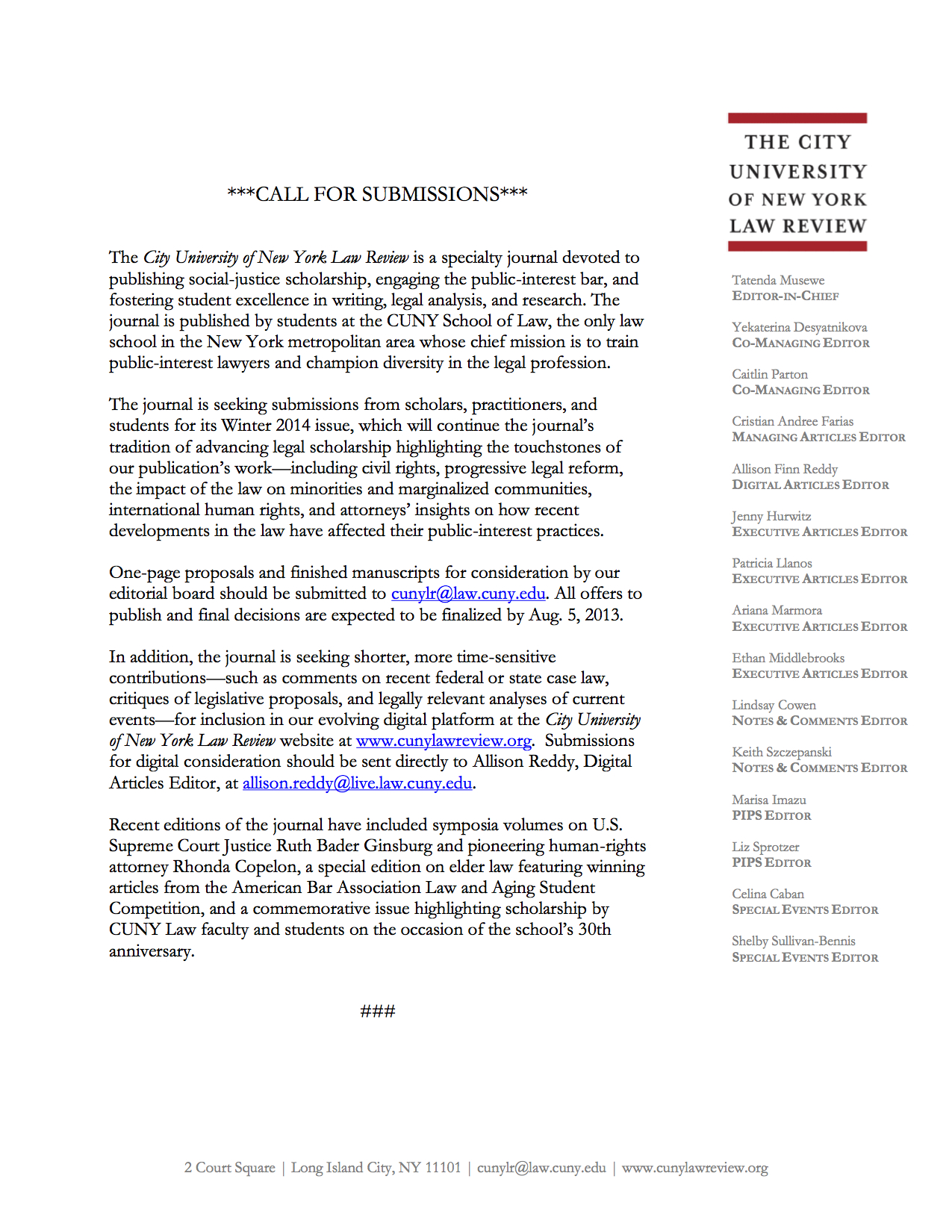
Call For Submissions

CUNYLR Call for Submissions (May 2013)

Click to view our letter.

The City University of New York Law Review is a specialty journal devoted to publishing social-justice scholarship, engaging the public-interest bar, and fostering student excellence in writing, legal analysis, and research. The journal is published by students at the CUNY School of Law, the only law school in the New York metropolitan area whose chief mission is to train public-interest lawyers and champion diversity in the legal profession.

The journal is seeking submissions from scholars, practitioners, and students for its Winter 2014 issue, which will continue the journal’s tradition of advancing legal scholarship highlighting the touchstones of our publication’s work—including civil rights, progressive legal reform, the impact of the law on minorities and marginalized communities, international human rights, and attorneys’ insights on how recent developments in the law have affected their public-interest practices.

One-page proposals and finished manuscripts for consideration by our editorial board should be submitted to cunylr@law.cuny.edu. All offers to publish and final decisions are expected to be finalized by Aug. 5, 2013.

In addition, the journal is seeking shorter, more time-sensitive contributions—such as comments on recent federal or state case law, critiques of legislative proposals, and legally relevant analyses of current events—for inclusion in our evolving digital platform at the City University of New York Law Review website at www.cunylawreview.org.  Submissions for digital consideration should be sent directly to the Digital Articles Editor, at ldavis@mail.law.cuny.edu.

Recent editions of the journal have included symposia volumes on U.S. Supreme Court Justice Ruth Bader Ginsburg and pioneering human-rights attorney Rhonda Copelon, a special edition on elder law featuring winning articles from the American Bar Association Law and Aging Student Competition, and a commemorative issue highlighting scholarship by CUNY Law faculty and students on the occasion of the school’s 30th anniversary.

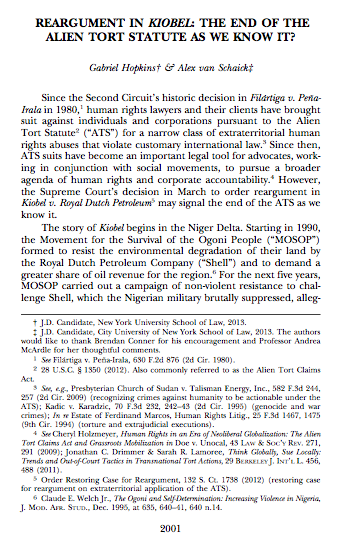
Web-Exclusive: “Reargument in Kiobel: The End of the Alien Tort Statute As We Know It?”

ReargumentImage

Article, Vol. 15.2

The CUNY Law Review is pleased to release our first-ever web-exclusive article as a companion to Issue 15.2’s release. The article, titled “Reargument in Kiobel: The End of the Alien Tort Statute As We Know It?,” was co-written by CUNY Law student Alex van Schaick in collaboration with NYU Law student Gabriel Hopkins. Stay tuned for more web-exclusive content from the CUNY Law Review.


Event: From Main Street to Court Square: Thirty Years of CUNY Law and Alternative Models of Legal Education

The City University of New York Law Review would like to invite you to a discussion on the merits of alternative forms of legal education, From Main Street to Court Square: Thirty Years of CUNY Law and Alternative Models of Legal Education. The event, with dinner and reception to follow, is taking place Wednesday, February 6, 6:00 PM, in the Auditorium. The discussion will feature:

  • Hon. Kristin Booth Glen, N.Y. Surrogate’s Court; Former Dean of CUNY Law
  • Prof. Pamela Edwards, Director of the Center for Diversity in the Legal Profession, CUNY School of Law;
  • Adam Shoop, Law Graduate, The Bronx Defenders, CUNY Law ’12
  • Prof. Frank Deale, CUNY School of Law (Moderator)

Come hear panelists discuss and debate the merits of alternative forms of legal education; the implications of race, class, and access in legal education and practice; the role of CUNY Law in the legal landscape, past and present; and the role of practitioners and law students in shaping the future of legal advocacy.